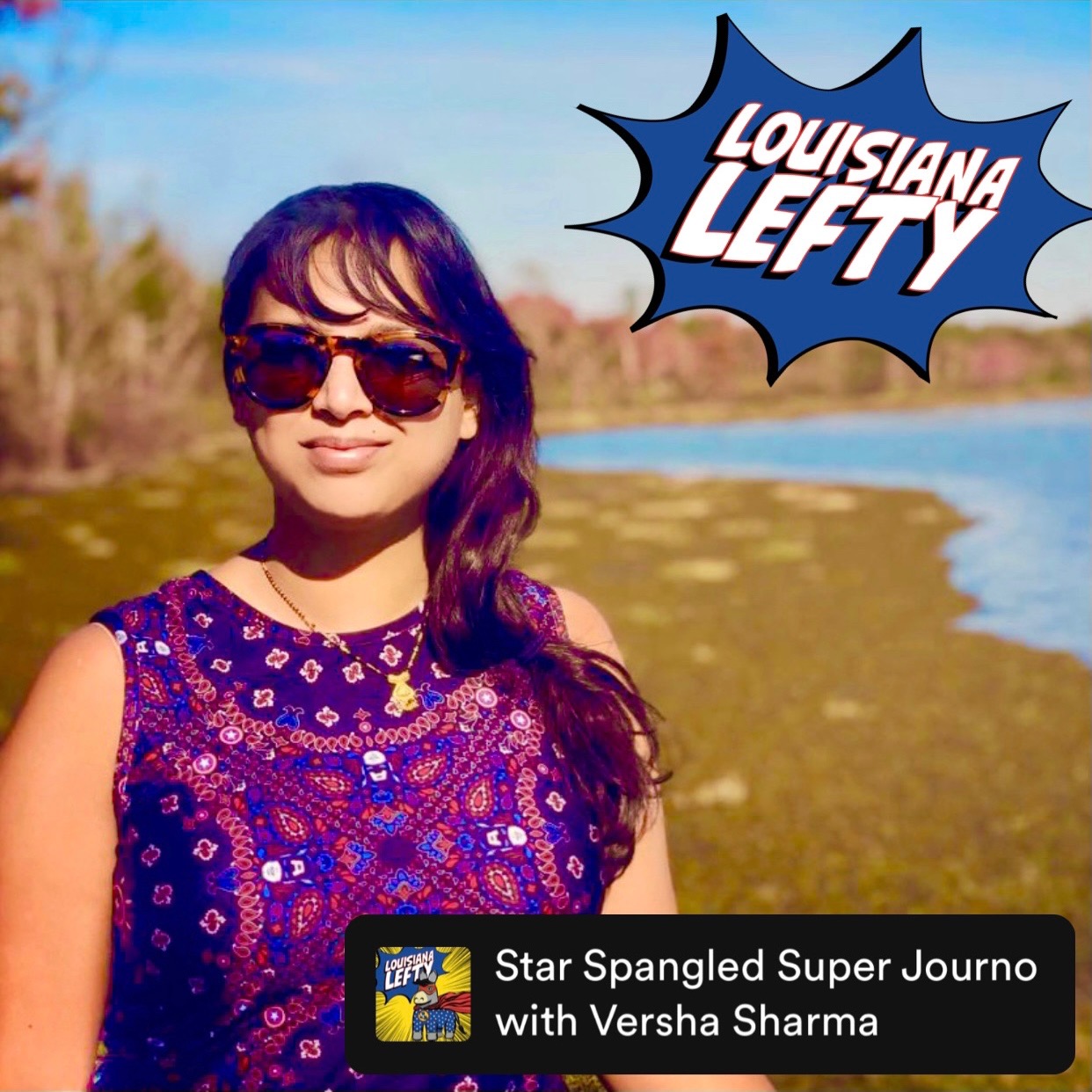
Versha Sharma, Alexandria native and journalist with Now This!, joins host Lynda Woolard for a conversation about the role media plays in powering our organizing, combating disinformation, and saving democracy.
You can connect to Versha’s work with Now This! at nowthisnews.com and all social media platforms.
Follow @LouisianaLefty on Facebook, Twitter, and Instagram.
Thanks to Ben Collinsworth for producing Louisiana Lefty, Jennifer Pack of Black Cat Studios for creating our Super-Lefty artwork, and Thousand Dollar Car for allowing us to use their swamp pop classic, Security Guard, as the Louisiana Lefty theme song.
Versha Sharma 23:20
I think it’s probably the biggest challenge that we’ve dealt with in recent years, and that we will continue to deal with. A positive for 2021 is that we no longer have a president who is, as has been described by CNN analysts, the disinformation agent in chief. And you know, there was the Washington Post tracker, Trump told more than 30,000 lies during his time in office. We’ve just never had a US president who lied, or misled, or gave false claims, to the extent that he did, or at the pace that he did. So journalists have been overwhelmed for four years, or honestly, five years going back to his campaign. I know a lot of journalists are taking a little bit of a sigh of relief, not quite yet, not fully exhaling, because there’s there’s still so much work that we have to do. And you know, even after his his term was over, we had the important second impeachment trial in the senate. He’s certainly still pushing the Big Lie, that he somehow won the election and Biden lost, which has been disproved, you know, over and over and over again. So it’s just been it’s been an overwhelming couple of years in that regard.
Lynda Woolard 24:37
I also wanted to talk to you about the scourge of false equivalencies and both siderism. You mentioned climate change being a big issue for young people, and that seems to be a really obvious example of this, where you have climate scientists who like 90 some percent agree on the moment we’re in, and the actions we should be taking, and then a small percent who call it a hoax or deny it, and either out of honesty, or some using it as a political tool, yet both sides are often treated as if they’re equal, as if they have equal weight. Am I over exaggerating that as a problem for our media?
Versha Sharma 25:18
No, I don’t think so. You’re not over exaggerating that, it’s still a problem. I think we’ve seen a lot of progress on that. I feel like I’m using that word so much today. But I mean, if not on Louisiana Lefty, when is the time that I will use the word progress over and over again? But truly, we have seen progress on that in media in recent years, not as much as I think you or I would like to see. But we’ve also seen a divide between the legacy, older, more traditional institutions and the new media startups, like Now This, and like other organizations, where you’re more likely to see the New York Times make a both sides argument or false equivalency, than you obviously Now This do it. I mean, that’s one of the things that sets us apart from the New York Times. So I have been on a crusade against false equivalence in journalism from the beginning. It is a huge passion of mine in that regard, because I do feel like what has contributed to the factual decline of American democracy is this increasing polarization that we’ve seen between the parties, the increase in misinformation and disinformation, as you were just asking about, combined with the idea that reporters or news organizations should give equal weight to both sides. And “Republican Congressmember said ‘x’ and Democratic Congressmember said ‘y,'” but the article doesn’t tell you which one is true, or which one is based in reality or has science that backs it up, that’s not helpful to anybody. It’s not helpful to readers, to American citizens, to people who are voting for these policymakers. So it’s harmful. I think it can be harmful to journalism and the journalism mission of informing the public. And it’s harmful to democracy. It’s not necessarily the best or most effective way at educating an electorate either. So I do agree with you. I think it’s still a problem. We’re getting a little bit better, but we’re not quite there yet.
Lynda Woolard 27:22
Okay. Now, much was made over President Obama’s campaign being better at communications than his administration when promoting their agenda. Do you see any early signs that some of those lessons were learned by the Biden administration and that they’re attempting to address that?
Versha Sharma 27:40
Yeah, I absolutely see some signs that that’s changed. I mean, Obama, the Obama campaign really pioneered a lot of what we see, you know, how campaigns use social media, they were the first to do it, because that’s how tools were evolving in 2008, and 2012. 2021, we are in a completely different social media space. And I have seen that the Biden team knows that, and they are using that, and they are staffed with young people who are digital and social natives, some of whom have actually worked for Now This, in the past. So that’s one thing that I know they’ve learned from their social learnings, in that regard. But you know, I see the Biden administration, I think, is incredibly active on Instagram, for example. And they’re active, not just about promoting, you know, mask use and public health advice from both the president and chief medical adviser Dr. Fauci, but they’re also using Instagram to announce their policy achievements. So like the American Rescue Plan, putting out shareable infographics and important statistics about how how much relief families are going to get, and I have seen them making a concerted effort to do that, I think on Instagram, Facebook, Twitter, all social media, really. So that already feels like an improvement from past administrations that were even less, I think, policy focused on social media. But I think they’re eager to show that this is a serious administration, when it comes to caring about governance. And yes, people are going to have policy disagreements, and Biden is going to be criticized for various decisions, as he should. We have to hold every president accountable. But I don’t think you can draw more of a contrast when it comes to actually caring about functional government and governance between the Biden and Trump administrations, and I think they’re really trying to use social media to highlight that.
Lynda Woolard 29:38
Cool. Well, let’s talk about some of your reporting specifically. In what seemed like a full circle moment, I guess you did interview President Obama. Was that his last year in office? 2016?
Versha Sharma 29:51
Yes, yes. Yes, it was. It was one week before the November 2016 election, so he was still in office, and he was on the campaign trail for Hillary Clinton.
Lynda Woolard 29:59
What was that like for you?
Versha Sharma 30:00
That was full circle, as you say. I mean, he really kick started my career in politics and political media. And I was able to tell him about Caddo Parish before the interview, which I was pleased to be able to pass on that message from Northwest Louisiana. And he said he was very grateful, which was nice. But it was a full circle moment. And I mean, some of my favorite memories, I guess, is that we were promised 10 minutes with him, which, you know, 10 minutes with a sitting president, for a younger news organization is pretty great. But we were able to stretch that into 22, which I’m incredibly pleased about from a journalistic point of view, that I kept him talking, and he was interested in talking and answering questions. And there’s a great moment in the interview where, if you’re not paying attention, you can’t tell. But I had note cards on my lap with my questions on them, which I went over a million times beforehand, so I was prepared, I already knew what I wanted to ask, but I had them on note cards to consult, just in case. I didn’t look at my note cards until halfway through the interview, when I knew we were starting to run low on time, and I just wanted to make sure I was getting to everything. So the first time I looked down at the note cards in my lap, I realized that they’re upside down. And they’ve been upside down this whole time. And so I mean, Obama can’t see them or anything, that’s just like how I was looking at them. And so it is on camera, you can see me just slowly kind of rotate the cards in my lap, while I’m talking to him, to check, so that was a fun memory. But you know, obviously, I was incredibly nervous. It was a wonderful opportunity. And I’m very glad I was able to do that for Now This. And he was very gracious with his time. And, you know, we even pressed him on some issues. And made some news. So I think that was all around a good experience.
Lynda Woolard 31:59
I love that. Have you been able to speak to Governor Edwards?
Versha Sharma 32:02
I have not. Actually, I know, I asked you actually a couple months ago, or even close to a year ago this point. I’ve tried. So if you or anybody listening to the podcast can still help us get an interview with Governor Edwards, we would love to do that. I’ve been in touch with this press office. He is understandably very busy, and has been very busy. But we would absolutely love to interview him for Now This, if we can.
Lynda Woolard 32:29
Very cool. We’ll see if we can keep pushing for that.
Versha Sharma 32:32
Yeah, thank you.
Lynda Woolard 32:33
And you went to Russia? I’m gonna be honest, I was terrified for you, when you went to Russia. At one point in my life, I would have been loving being able to go on that trip. But I do not think I would want to go there now. Were you worried for your safety when you went?
Versha Sharma 32:48
I was. And especially because I was traveling alone, which I wouldn’t necessarily recommend for a journalist, but especially for women. I was worried. I took precautions beforehand to protect myself, you know, digital security, made sure I knew what the laws were. So I was a little bit nervous. But I was connected with Russian journalists in Moscow, who were guiding me and showing me around, both accompanying me to field shoots, and also just helping me out with translations. So I’m very thankful to Russian journalists for that. But yeah, it was an absolutely fascinating trip. And honestly, it’s unfortunate where we are now, because I would recommend everybody go to Moscow one day, if they ever can. It is a beautiful city, I think maybe surprisingly beautiful for a lot of Americans. But it’s a gorgeous city, obviously, full of fascinating history. And the culture is, of course, a little bit different to the government, which is, you know, what I was reporting on at the time, and certainly can be very intimidating to reporters. But I’ve always been fascinated with Russia, from, you know, Cold War history onward. And I think, particularly the ties to the Trump administration, and how it affects us in terms of foreign policy. It’s just been really fascinating to see all the ways that it’s intersected with US politics in recent years.
Lynda Woolard 34:22
Am I wrong to be suspicious of Senator John Kennedy for spending his fourth of July in Russia?
Versha Sharma 34:29
No, you’re not wrong. And honestly, I would love to ask Senator Kennedy some questions about that, if I ever have the opportunity. There’s still a lot of open questions about who pays for some of these lawmakers’ trips, and why they’re there. And I’m glad you bring it up, honestly, because I think a lot of people forget about the story. It is notable that it was the Fourth of July, specifically, that they spent there, at a time when Russian Government and agent ties to the Trump administration and campaign were under such intense scrutiny, and rightly so. Yeah, I think there’s a lot there’s still a lot to investigate with regards to the Republican Party and some of these trips.
Lynda Woolard 35:18
I mean, yeah, it was fishy to me, but I think you’re right, the Fourth of July made it particularly notable, right?
Versha Sharma 35:25
Yes. Yes.
Lynda Woolard 35:26
It’s just an odd choice to me. And I just actually earlier today found an Instagram you posted back in January, that was a screenshot of your mom responding to one of my Facebook posts, calling out Senator Kennedy for his objection to the election results after the chaos of the insurrection on January 6th, and her simple reply was: he need to go. And I loved that. I’m with your mom on that.
Versha Sharma 35:55
Yeah. Seeing my mom get increasingly involved in politics and on social media has been very entertaining. For sure.
Lynda Woolard 36:05
Back in our country, have you felt generally unsafe being a woman in the public eye, particularly because your work is so prominent on social media, which is sort of a breeding ground for aggro misogyny?
Versha Sharma 36:16
Yeah, yeah, you’re exactly right. I am frequently harassed, both on social media, sometimes in person. There are certainly times when I’ve been conducting field reporting where I felt unsafe, whether, you know, it was a Trump rally in New Hampshire, is the first one that comes to mind. I just remember being there, and I was one of like, three non-white people in the arena. And a Trump rally attendee asked me if I was Muslim. You know, first of all, just the question, and I’m not, but would it matter if I were? And so I was like, “Does it matter? Like, why?” And he just, like, walked away. So at least, that was not an engaged interaction, but certainly, I felt unsafe. I mean, I’ve reported about a number of white supremacist rallies at this point, or events or, you know, religious extremist events around the country. And those can be particularly intimidating for women of color. And the harassment that women journalists face online, I think is a problem that people are only just starting to understand the magnitude of. It’s happening to another one of my good friends today. Her name is Taylor Lorenz. She’s a reporter for The New York Times. And Tucker Carlson singled her out on his show last night on Fox News, and said her name five times. And you know, we know from experience and from interviews that he knows exactly what he’s doing when he decides to sic his followers on somebody. And of course, it is a younger female journalist, who has done nothing to offend Tucker personally. But he has decided that he takes offense to her and her success. So things like that happen all the time, unfortunately. And I’ve definitely faced my share of death threats, or rape threats, or other harassment, or people impersonating me online and starting fake Twitter accounts to troll me. I just reported another one of those, just before this, actually. So it’s a problem. It can be really exhausting. But I think I haven’t let it stop me working yet. And I don’t plan to let it stop me going forward.
Lynda Woolard 38:37
Good. Good for you. You had an intense reaction to the insurrection that Now This shared to all its platforms. Your repeated refrain was “I’m angry.” It was very powerful, really encapsulated four years of Trump and trumpism, which that January 6th riot was a culmination of. Were those thoughts you’d been waiting for a moment to get out? Or did they really just bubble up that day?
Versha Sharma 39:02
Thank you for saying that. Yeah. I think it was both. I think a lot of them were things I had been feeling for some time under the Trump administration, because I do talk about the increased threats that we’ve all faced. Like, yes, women and women of color have it particularly bad, but honestly, threats and crimes against journalists have been up across the board in the last four years. And we know that’s because President Trump called journalists ‘enemies of the people’ for however many years. I mean, that’s fact based data that we have showing the correlation between this rhetoric against journalists and the press, and an increase in threats and violence. So that’s the problem for journalists, in general. And part of that was what was driving my anger in that response, because I can so viscerally remember January 6, and if it weren’t for the pandemic, I would have been there, right? I reported on Trump’s first impeachment trial. I’ve been there, I’ve been down in DC for sort of like all the major electoral events. The only reason I wasn’t there was because of COVID-19 travel rules. So one, I knew that I would have been there. And two, I had friends who were reporting there that day, and I was watching, you know, Igor, from the Huffington Post, tweet these videos of people trying to break into the Capitol building, and just how scary it was to watch a literal angry mob banging on windows and barricades, and breaking it down, and knowing my friend is there, six feet away, and all he’s trying to do is do his job. Like, it’s the fact that it got to this point in the United States, and we saw everything that was leading up to it right? It shouldn’t have been a surprise. And I think that’s also part of what motivated my anger is, these are threats that I’ve been reporting on for five years, at this point. We tried to warn you that Trump was promoting white supremacy and anti democracy and trying to overturn the results of a legitimate election. You know, journalists have been trying to warn people of his condoning of violence, and even encouragement and violence, at a lot of his rallies. You know, it was on tape, he would say it on stage behind the podium, like, “Yes, beat up that protester, I’ll cover his legal fees.” We’ve been reporting on this for years, and it shouldn’t have been a surprise that it got to this point. And yet, it was, and it was horrifying. And it’s absolutely tragic that five people died. And I think, you know, it’s seven people, if you take into account officer deaths afterwards, which is just absolutely tragic. So I think it was a combination of having been a reporter on the frontlines of the Trump administration for four years and seeing all the trauma, myself, firsthand, and what it’s done to my colleagues and my friends. And then, the fact that it got so bad, despite journalists trying to warn people for so long, that it got so out of control, that crowds are marching through the halls of the Capitol looking for Mike Pence, and threatening to hang him. I mean, he is Trump’s vice president. And so if people can’t see that as a wake up call, of where we are, you know, very critically as a democracy, then I probably can’t open their eyes further at this point, but I wanted to at least narrate that feeling, and explore it for people. I got a lot of positive responses from people who were like, “Thank you for saying this, like this is how I’ve been feeling.”
Lynda Woolard 42:46
You spoke your truth, and I’m sure it was a truth for a lot of folks. You also talked about being exhausted. How much do you worry about these Trump terrorists as an ongoing problem?
Versha Sharma 42:58
All the time, all the time. Good news is Merrick Garland was just confirmed as attorney general. And I’m happy for that from like a Civil Rights point of view, purely, again, not partisan. But he has pledged to take on domestic terrorism, and investigate white supremacy as a form of it. The FBI has made over 300 arrests, I think, at this point, so I’m glad to see that federal authorities are taking the threat of domestic terrorism seriously. But it is also exhausting to think about what a stranglehold Trump still has on the GOP and how much he will going forward. I mean, it’s absolutely still an issue. It is nice, and has been freeing to not have a Trump tweet or alert on my phone every single hour. I am less exhausted in that regard. But I’m absolutely still concerned going forward.
Lynda Woolard 43:55
Well, what warmed the cockles of my heart as an organizer is that you used the moment as a call to action. And you ended your video asking for your followers to get more involved with the process, in making things better. So I liked that. From that dark day of the insurrection to the brighter day of the inauguration of Joe Biden and Kamala Harris, you predicted that the public would fall in love with the Youth Poet Laureate. I think there was a lot on the dais that day that spoke to hope for the country, but Amanda Gorman really became an avatar for that, I feel like. How had y’all connected before that?
Versha Sharma 44:37
Yes, Amanda is phenomenal. And this is what I tweeted like 15 minutes before she took the stage: I can’t wait for everybody else to see the talent and wonder that is Amanda Gorman. I mean, she has become even more popular than I could have imagined. So I’m so glad for her success. I first met her in 2017 at a Women in the World event. You’ve probably heard of it. It’s a great event put on in New York annually, usually in person, but it has been virtual, where the organizers just bring together all sorts of influential women, organizers, activists, elected officials from all over the world, to celebrate them, and to celebrate their work and their success. And Now This was backstage doing interviews with a lot of the speakers. I also got to meet and interview Oprah, that same event. So that was great. I mean, two amazing women, Oprah and Amanda Gorman, I met at that one event. So it really was just fantastic. But I mean, I had no idea who she was. I knew she was giving a performance at that event. And as soon as she took the stage, I mean, I just had the same experience that everybody else did on January 20th. But you know, in April 2017, she took the stage, and she started speaking, and I just stopped in my tracks. I was like, I wanted to listen to her. She’s incredibly moving. She’s incredibly articulate, and just a brilliant writer. And she took my breath away with her performance. And I was like, “Okay, I need to talk to her, whoever that is, I need to speak to her.” So, you know, she came backstage, she was, I mean, even younger at the time, so I think she might have been 18, or maybe even 17, but she was delightful. You know, she’s a fan of Now This, which I was glad to hear. She was a young person, who loves Now This, and did a quick interview with us. And we stayed in touch after that, because, we just it off, and we care about a lot of the same issues. We’re both women of color in media. There’s just a lot to talk about, so since then, I’ve kept in touch with her. She has done some great pieces for Now This. She did one couple years ago about abortion bans, and how that was becoming an increasing trend across states. And again, it happened today in Arkansas. It was just a fantastic piece for advocating for Reproductive Rights. So I have just been in awe of this young woman who is incredibly talented and smart, but also really passionate about change and advocating for change. And, you know, that’s a perfect fit for me, and for Now This.
Lynda Woolard 47:24
Well, it was fun watching her social media blow up that day. And her reaction to that was so heartwarming.
Versha Sharma 47:30
Yes.
Lynda Woolard 47:31
Did her appearance that day, or for that matter, the swearing in of the first woman as vice president, and a woman of color, in particular, counter any of the anger you had experienced on January 6th?
Versha Sharma 47:42
It did, it did. And again, little bit of lingering resentment to COVID and to the insurrection, because that would have been another case where I would have been present at the inauguration in DC, if we could be. So I’m sad, you know, for all of the younger women, you know, girls and boys, who didn’t get to see this historic swearing in of the vice president. And, you know, I’m also an Indian American. So I am particularly excited to see the first South Asian American to be vice president, in addition to the first woman and the first black woman, which are also huge achievements. But I think I contrast Trump’s inauguration speech in 2017, which I call the American Carnage speech, and I talked about that in my op-ed response as well. I mean, again, I don’t think there could be more of a contrast between who Trump and Biden are as people, let alone in terms of policy. Biden is a very empathetic person. And I’ve had the opportunity to interview him twice over the years. He is a genuine person who cares about people. And I don’t think anybody says that for Trump, not even people from his own party. And then I’d add one thing that was also very healing came, maybe a month later, when Biden and Harris held that ceremony commemorating that 500,000 Americans have died from COVID-19. And if somebody listening hasn’t seen it, I really just highly recommend you go back and watch that ceremony and that speech. It’s incredibly, incredibly emotional. Obviously, Biden, having suffered so much personal loss of his own, in his own life, makes him particularly good at handling and expressing grief and relating to that and others. And I think, again, that is such a contrast with the former guy, but on its own, just to have recognition of how many people that we’ve all lost, something the previous administration wouldn’t even acknowledge. So it was very healing – as sad as it is that we crossed this milestone – I think it was important that we marked it.
Lynda Woolard 50:07
Is there a story that you’ve covered that you think of as the most important work you’ve done?
Versha Sharma 50:14
Oh, that is a tough question. I feel that way about a couple of my stories. I think one that comes to mind often for me, and first, is a story I did about the death penalty in Texas a couple years ago, and particularly interviewing and spending time with a family where the son’s father had been killed in a convenience store robbery. And the assailant had been sentenced to death, he was on death row and due to be executed, and the son of the victim was advocating for clemency and asking for clemency and did not want him to be executed. And he told us, “If my dad were still around, I don’t think he would support this. I just thought about what my dad would do, and I don’t think taking another life away, it’s not going to bring him back. So, why would we want to do that?” And just the idea of rehabilitative justice, and conversations that are happening nationwide, but especially in Texas, where use of the death penalty is so prolific, that one sticks out, I think, as one of my more more important ones.
Lynda Woolard 51:29
Strong, strong. And you met your husband doing this work, right?
Versha Sharma 51:33
I did. Yes. We both worked at Talking Points Memo. Oh, gosh, I met him in 2012, when we were both there. So yes, I didn’t know it at the time. He was an intern when I was a staffer there. I left, but that is how we connected, and got together a couple years later.
Lynda Woolard 51:51
And he’s still doing the same line of work?
Versha Sharma 51:54
He is. Yes, he is an investigative journalist. He’s got a book coming out this October. Very excited for him.
Lynda Woolard 52:00
What’s the book?
Versha Sharma 52:02
It’s called American Kleptocracy, and it’s about his beat. And his passion is investigating financial secrecy laws that allow all sorts of people, oligarchs and dictators, to hide their money, either in US banks, or tax havens, or property. So it’s all about what kleptocracy is, what it means, and how the US can hopefully alter its laws to change that, going forward.
Lynda Woolard 52:31
I look forward to that. Well, last three questions. From your perspective, what do you perceive as our biggest hurdle in the American political system right now?
Versha Sharma 52:42
Hoo. Our biggest hurdle is that, I think, roughly 33% of Americans, or at least American adults, American voters are okay with some strain of authoritarianism. And that has been crystallized during the Trump years. And I think they’ve been there in some form for, you know, the entirety of this country’s history. We talk about Jim Crow laws and the Voting Rights Act, and going back to segregation before that. It’s always been a problem. But I think there is also a strain of the electorate that is increasingly disconnected from reality in ways that we haven’t seen, thinking about Q-Anon people, thinking about various conspiracy theories. And these conspiracy theories were never mainstreamed at the highest levels, as they have been in the Republican Party and the Trump administration in recent years. So we just have a big fight and challenge ahead of us to continue protecting democracy and championing it, because we’re gonna have to. I think Obama has said something like this, and the late John Lewis, as well, that you have to fight for democracy constantly. It’s not just something you can take for granted, or you can let it sit there and leave it alone and assume that it will be okay. That’s never going to be the case.
Lynda Woolard 54:16
Well, that sort of probably leads into your answer to this question, although I shouldn’t say that before I ask it. So for same topic, American political system, what’s our biggest opportunity?
Versha Sharma 54:31
Oh, I love that. I think at least in my lifetime, there has never been more interest in politics and policy. I think more people are paying attention to politics than ever before, and not just national presidential congressional level races, but the pandemic and the climate crisis, I think, have really crystallized for people how important local races are. Criminal justice reform, the Black Lives Matter movement, the fact that it’s your local DAs or prosecutors who affect police accountability, I just think there’s such increased public interest in local races. And I think that is our biggest opportunity for education. And for pushing for progress going forward is, “Okay, we have a great inflection point where more people than ever before are paying attention, let’s not lose this opportunity. Let’s use it as a teachable moment to show people this is what it’s like to have functional government during a pandemic. This is how it can change your life and help you and change things for the better instead of worse.” Uphill battle, again, looking to Governor Greg Abbott in Texas, for example, but I think there there are huge opportunities there.
Lynda Woolard 55:51
I like that. I like that. So this last one has, I guess, two parts to it. Now This has a lot of spin offs. And I’ve really lost track of how many different spin offs, like Now This Politics… but I like so many of them. Was Now This Nerd your idea?
Versha Sharma 56:07
Now This Nerd! It was not solely my idea. It was kind of like a collaborative idea between me and a couple other people. But yes, I can’t take, you know, sole credit for that, but it’s certainly one of my favorite ones that we have.
Lynda Woolard 56:23
Well, you may have noticed we have a superhero theme to our podcast, partially because I’m intent on lifting up organizers as superheroes. Do you have a favorite superhero? I feel confident that you do.
Versha Sharma 56:38
Yes, it is Captain America, which probably isn’t going to surprise people after all of my talk about democracy and patriotism. But yeah, he’s my favorite for a couple of reasons. Yeah.
Lynda Woolard 56:51
I love that. Well, thank you so much for your time today, Versha. You’ve spent some extra time with me than we even asked for, so I really appreciate that. And we’ve already talked about how people connect to your work, all the platforms you’re available on, so I hope people will go look up Now This, if they’re not already following you, which we know you have a huge following. But I’m just so grateful to you. I love following you on all the Now This outlets. You are a credit to Louisiana, and an inspiration, and much appreciated. So, thank you.
Versha Sharma 57:21
Thank you, Lynda. I really appreciate that. It’s great to talk to you.
Lynda Woolard 57:25
Thank you for listening to Louisiana Lefty. If you’re not already a follower of Now This News, please find them as well as Louisiana Lefty on Facebook, Twitter, and Instagram. Please subscribe to this podcast and help us grow with a glowing review.
Lynda Woolard 57:42
Thanks to Ben Collinsworth for producing Louisiana Lefty, Jennifer Pack of Black Cat Studios for our Super Lefty artwork, and Thousand $ Car, for allowing us to use their swamp pop classic, Security Guard, as our Louisiana Lefty theme song.