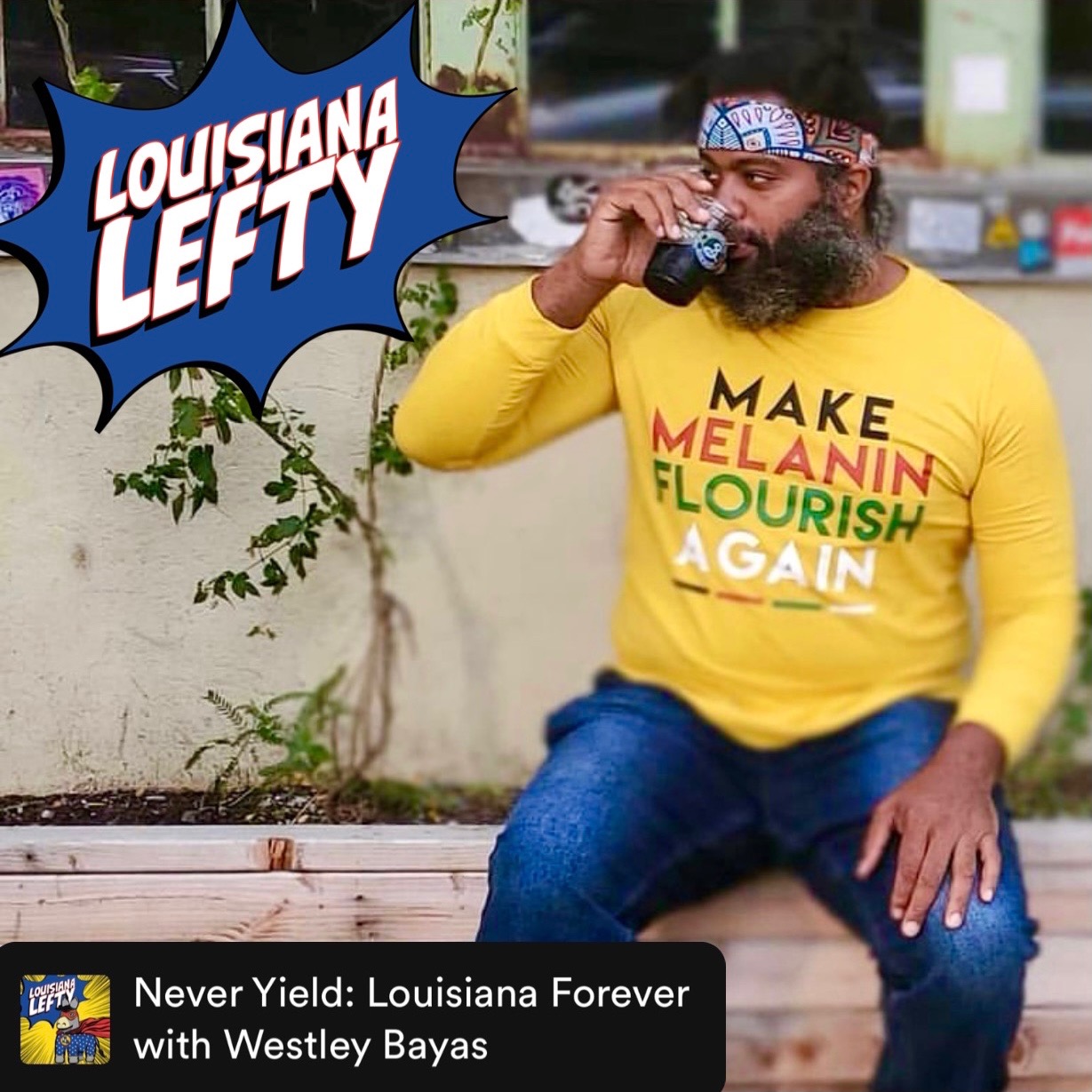
Political strategist and media consultant, Westley Bayas III, and host, Lynda Woolard, discuss paid media for campaigns, give advice for progressives considering a run for office, and underscore the importance of utilizing modern campaign techniques to level the playing field in Louisiana.
You can connect to Westley’s work at https://berlinrosen.com/campaigns/ and https://bit.ly/3aw0Te9
As promised, here is the photo of his costume: http://bit.ly/39vERs5
Thanks to Ben Collinsworth for producing Louisiana Lefty, Jennifer Pack of Black Cat Studios for creating our Super-Lefty artwork, and Thousand Dollar Car for allowing us to use their swamp pop classic, Security Guard, as the Louisiana Lefty theme song.
Lynda Woolard 0:07
Welcome to Louisiana Lefty, a podcast about politics and community in Louisiana where we make the case that the health of the state requires a strong progressive movement, fueled by the critical work of organizing on the ground. Our goal is to democratize information, demystify party politics, and empower you to join the mission because victory for Louisiana requires you.
Lynda Woolard 0:33
On this week’s episode, I’m joined by Political Strategist and Media Consultant Westley Bayas, who happens to be one of my oldest friends in Louisiana politics. We get into planning paid media for campaigns, advice for progressives considering a run for office, and the importance of utilizing modern campaign techniques to level the playing field in Louisiana.
Lynda Woolard 0:58
Westley Bayas!
Westley Bayas 0:59
Hey hey hey hey!
Lynda Woolard 0:59
… or as I call you, Westley “Liberal Bias.”
Westley Bayas 1:05
Always agreed.
Lynda Woolard 1:06
Thank you for being on Louisiana Lefty with me today.
Westley Bayas 1:10
Thank you. Thanks for having me on, Lynda. It’s always a pleasure to talk with you all the time. Every time.
Lynda Woolard 1:16
I always start with how I met my guest. And we met on the Obama Campaign in 2008 in Louisiana doing that good old heavy focus on voter registration and phone banking and organizing on college campuses, where I contend it was a great training ground learning organizing from some of the best in the business.
Westley Bayas 1:42
Agreed. I have been somebody that I tell people, listen, I’ll say it publicly, you have been one of my political mentors because you have always made a focus on organizing, and at the grassroots level, possible from the street, from the street corners, from the neighborhood blocks, from knocking doors. I’ve always referred to you as that because it always reminds me that all the work we do politically, if it doesn’t touch the folk that we are working for, not with before and with, then it doesn’t matter, right? Even the things I’m doing now, it doesn’t work if we’re not organizers at heart. So, I remember those days at Dillard. I remember those times working with you. And it’s always always been a pleasure to know that you stick to that, and it’s been really a big influence in my political life. So, thank you very much.
Lynda Woolard 2:31
Well, I’m so honored and touched to hear that, Westley. Thank you. Well, tell me your political origin story. What got you interested in politics in the first place?
Westley Bayas 2:41
Yeah, I’ve always been interested, I think, lightly in politics for a while. I can remember the 1994 New Orleans mayor’s race as the first time I ever was interested, I was 11 years old at the time, I was ever interested in electoral politics and just the breakdown of the different neighborhoods and the different political organizations and who they chose at the time. That was the start. Once I got into college, I got involved in electoral politics. I was an intern. My first political job was an intern at the Louisiana Democratic Party 15 years ago. And ever since then, I have just been focused–as an organizer working with you at the Obama Campaign and then with the DNC. I worked with Mitch Landrieu on both of his successful campaigns as a field director and then as a senior advisor on the reelect. And then I just got involved in advocacy work. So, in the years, I’ve worked on criminal justice reform. I’ve worked on reproductive health. I’ve worked on education transformation. I’ve worked on a lot of different issues that are really affecting Black and Brown people in our community. And then the last few years, I’ve really been focused on more of the consulting side. So initially, really as data and targeting and helping make sure we can run smart campaigns throughout Louisiana and the South using information qualitative and quantitative, and then the last three years, I’ve really been focused, as a consultant, on paid media. So how are we making sure our TV ads, our mailers, our digital ads, our radio ads, all the things that we spend money on in a campaign to really communicate with voters that are not field, sound and feel like the candidate? And this is really important because I remember, in 2012, in the Obama reelection, they had this big push for the new American majority. It was women, it was people of color, it was young folk, it was the LGBTQ community that helped bolster Barack in the campaign. And a little bit after that, I realized it didn’t make sense that we were going to have this group of people coming to power, and they were going to be running for office, and they couldn’t count on or depend on consultants that looked like them. To me, it is important, if you really want to tell the story of Black and Brown people, if you want to tell the story of LGBTQ folk, if you want to tell a story of young people, of women, that consultants have to be like them. They have to sound like them. They have to understand those stories because that’s the only way you can really get a good translation from sort of the base support to the general public.
Lynda Woolard 5:20
Okay. Well, let’s talk about the work you’re doing now.
Westley Bayas 5:23
Yeah. So currently, I’m a vice president for creative and campaign services with a firm called BerlinRosen. We are a Democratic only, political PR communications firm that’s based in New York City. And we work with candidates in organizations across the country in order to do a couple of different things. So, one is sort of general campaign strategy. Often the candidates and clients that we have, they don’t have the access to people that have experience being field directors or data managers or campaign managers or comms staff. So, part of what we do with the candidates we have is we help them just build out their campaign, help them build out their messaging. We can talk to them about their field operations. We can give them communications ideas. We can use our connections to help pitch stories. All the things that you sort of need, and what’s called, in the game, a general consultant. The second thing that we do and sort of the primary focus is we do paid media. So, I’ve had the chance, in the last few years, to work with candidates from Colorado to California, to Texas, to Florida, to New York, and literally everywhere in between, on helping define their message, help them find their base of voters, help find the people that they need to bring into the fold, and take sort of like, at times, stagnant policy ideas, something that doesn’t sound so poetic and make pieces of art in mail, right? Or make beautiful videos or make just things that people can attach because we know that maybe prior to 2016, people only spent maybe 10 or 15 minutes a week on politics. And we need to make sure we can communicate the idea as quickly as possible. Now, I think it’s a little different. I think the reason why we see a lot of the fatigue around politics is people have had to spend way more time than they’re used to. But that doesn’t mean that we don’t want to value people’s time and make sure that we can take an important message and articulate it as best as possible with the right kind of language and the right kind of words.
Lynda Woolard 7:34
I want to drill down a little bit. Your focus is mainly on ads, direct mail, digital ads?
Westley Bayas 7:43
Yes, me personally, I work on campaign strategy, and I work on creative ad production. So, our firm at BerlinRosen, we have in-house video and graphic designers. My job is to help articulate and create a message, create the language around it. We have copywriters who help with that. And we produce television ads. We produce direct mailers. We produce digital ads: static and video. We produce radio ads if you need it. We produce literature. We produce buttons if you need that. We can create a logo if you start with us from the beginning, right? Anything that you need that’s about paid media and getting out to the public, that’s what I do as well as like campaign strategy.
Lynda Woolard 8:25
For folks who are putting a campaign together or who just wanted to know more about the inner workings of campaigns, what percent of their budget would you think you would recommend they invest in these kinds of ads you’re talking about? I’m thinking more about your direct mail, your digital ads, maybe the TV ads, but not many campaigns are going to be able to afford TV ads, but those radio ads you mentioned, I think, are also important. So, if I was putting a budget together for a campaign, where would you tell me, what sort of percent of my budget would you want me to put there? And I know you want me to put all of it with you, realistically though.
Westley Bayas 9:10
Let me be clear, right? I’m gonna give you the number one answer in politics, which is: it depends. Right? It depends on the size of the client and all of those nature. What I would say is the average campaign wants to spend somewhere between 50% to 70% of their budget on communicating with voters. That can look in different ways, right? That can include your field operations and paid canvas, if you need to do that, as well as your paid media. What I would generally say is you probably want to spend at least 40% to 50% of your budget on direct paid media, especially if you have a large volunteer base that can really help with your phone banking, with your canvassing, right? That may even go up to 60% or 70%. It depends because sometimes some races need to bring in outsiders to pay their canvassers, to be able to help support them. But I would say, you want to spend at least half of your budget on paid media. And that’s because, and especially for your smaller races, your down-ballot races, your focus is going to be more targeted, right? You’re going to be sending mail pieces. You’re going to be having literature pieces. You’ll be doing radio ads. So, you want to be able to make sure that you’re really intuitive. In our business, we always think about you want to find your primary medium of communication and dominate it, right? For most down-ballot races, that is probably more like direct mail and digital ads and literature, maybe some radio ads. If you’re doing more of a city-wide or at-large race, that’s probably a little bit more TV, right? But you want to pick one medium, and you want to dominate it. And you want to be able to make sure that at least your opponents that you have around, you’re able to match or do better than the spending that they’re doing. But you always want to try to dominate one medium instead of trying to sprinkle a little bit in TV, a little bit radio, a little bit direct mail, you rather focus on one space and then try to build out your paid media campaign from there.
Lynda Woolard 11:10
Well, and the it depends point, I think, is relevant because also you need to be able to target your audience and figure out where they are, right? So, if you’ve got voters you expect would vote for you that don’t watch TV, there’s little reason to put TV ads up, right?
Westley Bayas 11:28
That’s correct. I mean, look, my general rule is for most, especially in Louisiana, for most state representative races, heck, for most state senate races and under–school board, you should never spend one dime on television, right? I would be like at malpractice, as a consultant, if I told somebody running for state house, or if you’re running for city council in most places that aren’t an at large seat, I would be at malpractice if I told you, you should spend money on TV, unless you had an outlandish amount of money, right? So, you want to be able to always find the best medium to target, particularly for smaller races, because you can generally predict the voters that you’re going to talk to. You can generally have an idea of, especially if it’s a Democrat versus Republican race, who are your base supporters and then who are your potential persuasive voters. So, I always say, the smaller that you get, the more targeted that you have to be. And you want to use mediums, such as direct mail and digital, where we can pull lists from databases, such as VoteBuilder or PDI, or if you pull something from the secretary of state, and you can actually target the voters that you want to get your message. So, you’re not speaking to folk who cannot vote in your election or people that will not vote for you, right? Sometimes in paid media, our idea is that we want to do no harm. And sometimes, that means that you have to not talk to people with a certain message that if they heard it, it would trigger them to actually vote for your opponent.
Lynda Woolard 13:02
Right. Right. And I’m going to push back a little bit on your percentage because I’m always going to argue for more field, but that’s just me. So, I always have to say that. I’m not necessarily–
Westley Bayas 13:14
That’s why I say, at the end of the day, 70% of your budget, and there’s discussions on breaking it down, but 70% of your budget should be on communicating with voters. And that looks a bunch of different ways. That could be a higher emphasis on field versus paid communications, right? That can be a higher emphasis on paid communications versus field if you’re in a more suburban area where the houses are spread out, and it just takes longer to knock doors. But in most places, in school board, you should have a huge field campaign because you’re only going to have a few thousand voters. So, you should spend a lot of money on field and building relationships because, at the end of the day, I will always agree with you on this, it is proven: the number one way to convince a voter to vote for you is if you knock on their door, and you meet them face-to-face, and you have a conversation with them. And most importantly, you listen to what they say. And you give them a reason why you are the best candidate to help deliver on their hopes and dreams, right?
Lynda Woolard 14:19
And when you’re saying that, you’re talking about the actual candidate?
Westley Bayas 14:22
I’m talking about the candidate. The next thing is a volunteer, right? But if you are knocking on somebody’s door, if you are calling them, and you’re having a face-to-face conversation where you can hear their emotions as they’re talking about the issues that are most important to them. They are sharing a personal story about something that has happened to them and why this race. That’s how you convince people. That’s the best way, right? The next best ways are through paid communication, such as direct mail or TV. There are all kinds of studies that are available that say the efficacy of those different types of mediums, but like I always would tell people, any campaign has to start at its field operation. It has to start with one-on-one conversations from the candidate to voters because there’s two things that the candidate can do better, you can hire anybody to do anything else except do two things for a candidate: raise money and tell voters why they should vote for them. Those are the two things that a candidate can do in their campaign better than anybody else, right? You can hire people to help you to do other things, but when a candidate makes the pitch from their own, when they say, “This is the reason why I’m running. This is my story. This is the things I care about. And this is, most importantly, why it matters to you the voter.” That’s how you can start winning campaigns. The things that I do are a part of a larger way to be able to communicate that passionate message that a candidate has to the general public.
Lynda Woolard 15:54
And just a side note to emphasize the point about candidates actually doing the work themselves, a simple example for me was when I ran for the local Democratic Parish Executive Committee, which is a small seat, and it’s just a party elected office. Nonetheless, you have to run. I was on the same ballot as Barack Obama in 2012.
Westley Bayas 16:19
Yes.
Lynda Woolard 16:20
At any rate, I did go knock doors in my neighborhood. I had a push card. I would talk to people. I’d leave my phone number with my neighbors. If they wanted to call me, I’d leave my number with them. So, they knew me already because I walk my dogs in the neighborhood.
Westley Bayas 16:36
That’s right.
Lynda Woolard 16:37
So they’d go, “Oh, you’re the woman with the dogs.” Now when people see me, with or without the dogs, I get asked questions like, “Are you still on the city council?”
Westley Bayas 16:49
Well, I mean, congratulations.
Lynda Woolard 16:52
They may not remember–
Westley Bayas 16:53
What a promotion, right? But they remembered you, right? And they know that you’re somebody that cares a lot about Democratic politics. And I think the other thing to keep in mind is you want to be able to touch somebody at least five to seven times in the span of the campaign. And the reason why paid media is important is, even with the field campaign, we know on your average canvas, you might get what 20%, 25% of your doors that open, maybe more maybe less? You can continue to knock those same doors, and you’ll still get 20%, 25%. So, paid media allows you to send information directly to somebody that, if they read it, it’s another touch, right? And it’s on top of a texting program that’s part of your field campaign. But you want to, in a perfect world after you create your win number, figure out a way in which you can communicate directly with voters somewhere between five to seven times. I think some studies have shown that once you get to like past eight or nine, then you kind of lose the effectiveness of it. But all of this is about layering how you are communicating to voters in different ways, whether they’re face to face, whether on the phone when they’re scrolling, whether in their mailboxes, or if they’re watching TV, to be able to drill down on the message. Because the other thing that paid media helps to do–it helps to enforce message discipline, it helps to make sure it can tell a story, and it helps to tell a story that is more comprehensive, at times, than sort of a two-minute phone call. Or if somebody only wants to talk to you for 30 seconds to get that piece of lip, right? So, we want to be able to make sure those same, fruitful conversations that people can have at doors can also happen through paid media and also overlay on top of each other to where, to your point, right, no people think Lynda is a city council member, right? But it’s because she has connected consistently with these voters over the campaign or over the years to where they know that if there is something going on in politics, particularly Democratic politics, I’m calling Lynda, right? And that’s how every candidate should be. You want to build relationships where people then remember what we call, in our business, the bumper sticker. What is that one sentence thing that you want somebody to remember about you? And that’s really where field plus a comprehensive paid media play can help drill in that one-sentence message.
Lynda Woolard 19:18
Back to our imaginary campaign. All of this requires careful planning and a timeline from the start. Is that something you help your clients with?
Westley Bayas 19:27
100%. I always tell people when they’re planning ahead, if they can, make a conscious decision 18 months out from election day that you want to be able to run because I also just think it takes about six months to have those initial conversations with people. If you have some things you need to clean up, you can clean those things up. And then at the same time, you can start interviewing potential campaign managers, potential consultants, all those. Because you want to be able to build a team and have a team in place, in a perfect world, about a year from election day. Now, for us, a firm like us, we don’t charge a retainer, right? Most of the work in which we get paid comes from the paid media services that we do because we also understand, to that point about a timeline, how important it is to have political and communication advice available to a campaign as it spins up. For us, our process in general for developing paid media really starts two or three, four months before a campaign really kicks up. In Louisiana, we generally want to get on board maybe three or four months before qualifying. So, now that I’m having conversations with potential people across the state who are thinking about running, to be able to get on board because part of what we want them to be able to do is, as they’re knocking on doors, as they’re giving their bio speeches, they’re giving their stump speech, we want to hear what are the things that are popping with people, right? We, as a firm, also want to be able to, we don’t necessarily have direct knowledge of the area, we want to be able to do research on what are the issues that are important, and this is especially important for local races, right? What are the local issues that people care about the most? What are the things that are going to pop during a campaign? What should we anticipate for? But really, our process starts maybe three or four months out from election day. We do candidate interviews, so we can really get to know the person that we’re working with. If it’s a candidate, I know that you talked a couple of podcasts ago with Jennifer Johnson about polling. If you can get polling done, we always like to have qualitative and quantitative information. And then we go through a process where we start with a mail plan. We literally bring the designer, the account staff, the copywriter that will be assigned from our team, and we actually conceptualize, based upon the budget allotment that we’re given by the campaign or anticipated, how many pieces we can mail based upon the universe or universes of voters we’re talking to. We try to come up with a general campaign narrative that can help inform our mail pieces. And then we start outlining what the pieces are. What’s the kind of photos that we think can help tell this message? Most mailers should only have about two or three hundred words. So, we want to get the right images that can help tell a story. We want to be able to think along with those images, what are the words that can help further along what you’re seeing visually as well as adding endorsements and some of those other things and the slogan and the voting information. Once we go through that process, and we send sort of like a four, five, six-page memo to the candidate, where they can review and see if they agree with our reasoning and our messaging and the universe, then we actually go out and we do a photoshoot. This is what I think is very important for people to think through when you’re doing planning for your campaign. Often what we’ll see is that candidates will do a photoshoot months or years out, and they’ll come in and say, “Here’s the photos that you can use.” But often those photos won’t tell the story of the current times and the current campaign, which we’re going through. What I always would advise is that we want to make sure that you have your message tight, you know exactly what it is that you want to communicate, then you go out and you get a photographer, hopefully, somebody that understands sort of the art of political photography, because there is an art to political photography that can help shoot the images in the right way. You have a firm, or you have a consultant that can tell you, here’s the types of volunteers that you need to recruit to be part of this shoot because we want to make sure that it’s accurately representing the constituency that we’re working with, the voters we want to speak to. We do the photoshoot and then internally, we start producing pieces, right? And generally, it just depends on how much somebody is able to spend. What’s the need? What’s the count? We like to start three or four months out because what we also appreciate, as campaign managers, as former data directors and communication directors, is that campaigns also have to worry about budget flow. So, we also want to make sure is that as things shift and change as money increases from fundraising, as money decreases, that we can make changes to the schedule to make sure that we’re getting once again, that repetitive message that comes out through paid media without a break.
Lynda Woolard 24:23
And the early voting information is really important as you’re targeting because you’re going to basically decide that you want to message to those people who normally early vote sooner than the rest of the voters.
Westley Bayas 24:38
Yeah. It all depends, right? I think in a state like Louisiana where we don’t have yet a super robust mail ballot culture, but we’re building that early vote culture pretty well, you want to make sure that you’re targeting early voters sooner, particularly with a field campaign, because early voters are people that make decisions earlier. They are most likely to be more informed on what’s happening on the race. They want to get it out of the way. So, these are like prime spaces to get volunteers, to get donors because these are folk that you’re able to communicate with. On our end, or if you’re in states where the early voting or mail process is a month or so out or starts a month or so out from election day, it’s important to communicate with those voters as part of the larger universe because as voters start up sending in or committing their ballots, we’re able to actually drop them off of our contact list, which means that we’re not spending money contacting people that have already voted. We’re continuing to be really smart with how we’re spending the allotment that we’re given from a campaign. And we’re also just making sure we’re targeting the voters who actually still need to hear what’s going on. But really in a place like Louisiana, you really want to make sure that you’re making your final argument before early vote starts because now you have 25%, 30%, 35% of the public who’s voting before election day, right? Election day is no longer election day. Election day starts two weeks out. And you want to make sure that you’ve made your final argument before early vote starts, so then the last week or two before the campaign, you’re really just trying to continue to emphasize that final argument as well as rising any endorsements that really seem important that voters should know about.
Lynda Woolard 26:28
And get out the vote.
Westley Bayas 26:30
Always get off the vote. The other thing, I know you’ve also talked to people, but it’s also a free piece of advice: IDs are everything. Knocking on doors, identifying voters are everything. It makes everything else from paid media to your canvas program, to your GLTV work the last two weeks so much easier when you actually know what people are going to do.
Lynda Woolard 26:52
When you say IDs, what you’re saying is we need feedback. We need enough field efforts done so that we have information from the voters telling us who our supporters are or who our potential supporters are.
Westley Bayas 27:05
That’s correct. You want to be able to make sure, if you know who your potential supporters are, you want to make sure they’re included in your field program if they’re undecideds. If you have supporters that you’ve identified, we want to include them because we want to make sure that they’re getting those reminders that they need to go vote, right? Conversely, if you know the people that are not going to support you, we want to drop them out the universe entirely, right? Because we don’t want to spend our money trying to convince people that have already said they’re not going to vote for you to vote for you, right? At the end of the day, smarter campaigns use information that they either collected through a voter file, or they’ve collected through their field operations to be able to build an idea of what the electorate is going to look like. And not just sort of based upon like demographic assumptions, which are good, but based upon real fact-checked, ground-sourced information that allows us to be able to understand what voters are thinking and feeling. And if we need to make any adjustments on our end, particularly from a paid media side, to make sure we are putting out the right argument that’s going to work for voters at that time.
Lynda Woolard 28:16
So, I just want to underscore all the things you’ve just talked about. The importance of sitting down as you’re putting your campaign together and having an actual calendar, where you calendar out all of this stuff, when it’s going to happen, when you’re going to roll it out, because it has to work in conjunction. So, you’ve got to, as you say, overlap or overlay the field with the direct mail, etc. So, things need to work together, and if you haven’t planned it out, you’re just kind of doing it harum-scarum. That’s not going to work.
Westley Bayas 28:53
Right. And always, for a number of the listeners, they may already know this, I think to that point to calendaring, we always work backwards from election day. I think often what we’ll see in paid media is people want to put out a TV ad early because they want to make sure people know that they’ve qualified. They want to send a mail piece out. But really in paid media, most things have a half-life of about seven to ten days. And then people sort of forget about it. What we don’t ever want to see is a piece of mail that gets put out eight weeks before election day, and then you don’t hear anything from that candidate for another four weeks, right? You’ve basically wasted your money then. It’s always the practice, the standard practice, to work backwards from election day with your budgeting, with your voter contact, with your paid media, with everything that you do because we want to ramp up to election day. This is all about ramping up to election day, not stops and starts, because momentum that you have a couple of months from election day, if it is not sustained, it will be lost, right? So, it’s very important. Thank you for bringing that up, Lynda. Having a calendar is important. And you want to make sure that you are starting from election day backwards. So that way you’re adequately thinking about your field plan, your paid media plan, your comms plan, all of those different factors, so that way you’re continuing to get that repetition. And politics is about repetition, right? And you want to be able to make sure you can drill down that message, and as best as possible, you do not want any break in that repetition.
Lynda Woolard 30:29
I want to pivot to something you and I have talked about a lot: old-school Louisiana political campaigns versus modern campaigns. And you and I’ve really been basing this conversation on modern campaign styles.
Westley Bayas 30:42
Like a decade. We’ve been talking about old-school versus new-school for like a decade, right?
Lynda Woolard 30:47
And look, some of it is because, I think, our training ground was the Obama campaign, which is sort of the quintessential modern campaign, right? But let’s define what we mean when we talk about these. Old-school to me is sort of dependent on endorsements, driven by consultants, yard signs, we’ve mentioned.
Westley Bayas 31:09
I think the way I’ve always perceived old-school, we say old-school sort of campaigns in Louisiana, has been to what you said, I think often, campaigns wait too late to start. Often, we’ll see really good candidates that will start at qualifying. In Louisiana, qualifying is generally two or three months before election day. They haven’t had their time to build their own relationships with constituents. They haven’t had that time to really be known in the community, to have those conversations, so then you end up thinking, if I just hired this local consultant who has these relationships already, they will extend to me. If I get this endorsement of this elected official, then this will extend to me because people voted for them already. They’re trusted. People feel like if I spend money on having sort of the ballots, that’s going to allow me to get a validity in my campaign. I think two things about that. I think one, times have changed, and I think particularly if we think about South Louisiana post Hurricane Katrina, populations have shifted. Populations have changed. Younger people are not buying into sort of the endorsements and the organizations in a way that they used to in the 60s and 70s. There’s also a reason for that. I’m going to get to that in a second. But people don’t buy into endorsements anymore. They don’t buy into sort of what they are given. They want to be able to do their own research. And most importantly, they want to have a relationship with their elected official. Especially if you’re like mayor down, there’s an expectation that I should be able to go find my mayor at the restaurant, right? Or at the grocery store, or at the second line, or whatever it is, right? So, there’s a really big importance on relationships. I think the second thing, as it relates to old-school campaigns, and I’m thinking particularly in sort of New Orleans and Baton Rouge, where you have some of your pro-rata organizations. Some of them are also like old vestiges of a patronage system that we had in Louisiana. Before, it was imperative to be part of one of these organizations because, and especially for people of color, it was the way you were going to get a job, right? You had to be part of these organizations. They will win an election. They’d have access to a couple of dozen jobs. And that was the way that you were going to actually be able to get hired in a good government job, which has generally been for people of color, the best way to have a steady income. I think as we’ve seen sort of this implementation of civil service of less political appointees and, for lack of a better word, patronage jobs, the power of these organizations has dwindled because they can’t deliver in the way that they used to, which is if you vote for us and this candidate, we can make sure you have a job, which means your family is going to be fed, which means you can have the dignity that comes with being able to do for your own. I think as we’ve seen sort of this implementation of civil service of less political appointees and, for lack of a better word, patronage jobs, the power of these organizations has dwindled because they can’t deliver in the way that they used to, which is if you vote for us and this candidate, we can make sure you have a job, which means your family is going to be fed, which means you can have the dignity that comes with being able to do for your own. That being said, because these systems have not evolved with the times, they have not really bought into the new-school ways of how organizations can work, which is really building a set of advocacy issues that they can constantly push that, even if they’re location based, that they’re using data to be able to target frequent voters to make sure that they’re communicating with them, build relationships and bring them into the fold of an organization or be able to identify new voters through voter registration. I think a little bit as they relate to communicating with voters, I know that they are starting to use a little bit more targeting, but it can also be like better, right? Because ultimately, the way we used to do campaigns used to be give us money, and we’ll deliver for you. And instead, often with new-school campaigns, if you’re using data, if you’re really targeting your voter in your voter database, if you’ve been building your field operation and getting those IDs that we referenced earlier to be able to understand your voter base, you can know: here’s the people I can count on, here’s the people I can’t count on, and everybody in the middle is up for grabs. And you can really spend your money trying to convince these people in the middle who have not made the decision on why you’re the best candidate. And this is very important as we’re talking about smaller campaigns that raise limited dollars, that only you’re going to be able to do so much. In my opinion, it’s always more important to be able to control your own destiny, identify your voters, and give them the message that you know works best for you and not necessarily hope that endorsements or organizational support, particularly if that organizational support is not providing you a donation or access to canvassers or access to IDs somewhere; it’s not the same bang for its buck as it was say 20 or 30 years ago.
Lynda Woolard 36:46
Those are all good points. And again, to underscore when we’re talking about a modern campaign, we’re talking about direct voter contact. Those one-on-one conversations, which is the gold standard of voter contact. But it’s targeted and data-driven. That said, it cannot be devoid of relationship building. You want to be having–
Westley Bayas 37:11
That’s correct.
Lynda Woolard 37:12
We talked yesterday a little bit about where I make a distinction between field organizing and constituency organizing. And field is sort of that–
Westley Bayas 37:21
Field campaign is like what? Three to six months during a campaign, but constituent is just ongoing.
Lynda Woolard 37:26
Right. So your constituency organizing, so constituent relationships are ongoing and important, but constituency organizing is something you really do have to focus on in a campaign, in my opinion, where you’re going to those allied groups who might be helpful to you in your campaign because the patronage stuff or those machine groups that may not have the same strength they once did in some ways are replaced or can be replaced by constituency groups, right?
Westley Bayas 37:59
They have been replaced, yeah.
Lynda Woolard 38:01
So that’s really who you need to be building your relationships with and maintaining those relationships with because none of that can be faked or shortcutted. It all takes time and sincerity. You have to really be an ally to the groups to ask them to be your ally in your campaign.
Westley Bayas 38:24
No, I agree with that. I one hundred percent because, and we’re seeing it now in the last four or five years as the Democratic Party has shifted fairly rapidly in how we view politics. When we worked way back in the day on Obamacare, I distinctly remember then that the public option was considered too radical. In 2009 and 2010, the public option is too radical, right? Now we’re seeing in the Democratic Party that the public option is too moderate, and we have to go Medicare for All. But if you haven’t been one of these people that, in the last five, six, seven years, understands that the next logical step or the next big step from Obamacare is trying to strive for healthcare for all, and you have not been part of those conversations. If you have not been working with those organizations, and you kind of show up in 2022, 2021 saying you’re for Medicare for All, people aren’t going to believe you. At least those organizations that are organizing around it, right? With social media, it’s a lot easier for people to check your bona fides, as I like to say. So, it’s easy to be able to see where folk have stood. And you have to have those relationships with those constituency organizations, especially the ones that are most aligned with your values. But it’s also just important, I agree with you 100%, you have to nurture and grow those but then activate them during a campaign because that’s your basis of volunteers. That can be your basis for support, already locked-in supporters. That’s your basis for donors, right? You have to be able to get them activated and ready to go for you during your campaign because now people are less sort of looking for work, they’re looking for values, and they’re looking for ideas. And there’s organizations that really focus on that.
Lynda Woolard 40:17
Well, the good news about developing those constituency relationships early on is it’s free. Time and time again, we see people run for an office they know they’re not going to win because they often say, “Well, this is gonna get my name out there. This is gonna get me known to people.” You don’t need to spend money and time on a campaign to get known to people. You show up at their events, and you get known to people. You turn up when they need bodies. You turn up when they need allies. And that’s how you build those relationships. It’s entirely free.
Westley Bayas 40:53
And look, at the end of the day, this is something I tell almost every single one of my candidates, and I tell them flat out, “I don’t give a damn about you. I give a damn about the voters you want to represent. And you are a vessel for what it is that they want and care about. And your values, your values as a person, as an individual, should already align with the values of the of the people that you want to work with.” So to your point, Lynda, if you have already been working with these organizations that are about healthcare, or they’re about economic justice, or they’re about criminal justice reform, if you have already been at their events and not always trying to speak at their events but holding a sign or making phone calls or knocking on doors, or retweeting their tweets or sharing the information along, you are building a relationship that cannot be broken because they know that you have delivered for them when you didn’t need anything. So, then when you are asking and, Lynda, this is something that you taught me that has always stuck with me. Everybody only has a certain amount of ask, right? So, you have to make sure every single one is quality, and every single one has value and purpose. So, if you’ve spent years fighting for the issues that are most important. You have been aligned with community organizations and advocacy organizations that are fighting for these causes when it is time for you, when you decide to run for office, and you put your name on the ballot, and you go back to that group, I don’t think there’s a better feeling in the world than saying, “You know me. Let me tell you the work I’ve been doing for you. So, you know that when I get to Baton Rouge, when I get to Congress, wherever it may be, I’m going to deliver for you because I’ve been fighting for you for years and fighting with you for years.” And that’s something that really, really matters, particularly when you get down-ballot in an election.
Lynda Woolard 42:57
That’s true. And I’m going to now pivot a little bit and say, while building those relationships is free, the other thing we do know from campaigns because of where we are, at least in this moment where money is so important to campaigns, it is still important to be able to raise money because all those other elements to your campaign don’t happen if you can’t raise money. So that’s still a huge, and I’ll talk to some fundraisers later on, but that’s still, for now in American politics, a big thing that people need to be able to do.
Westley Bayas 43:35
I think one, fundraising is the most important thing because unfortunately unless you live in one of these cities where you have public financing, and even if you are in a city where you have public financing, you have to be able to raise money to get your message out, right? That’s just the name of the game currently, unfortunately. I always think that, free plug for your fundraisers later, one of your first three hires should be a fundraiser. You should have a campaign manager. You should have a fundraiser. And then you should have hopefully like a media comms person. Because that fundraiser has the most important job. They’re going to make sure that all of the ideas that the candidate has, the concepts that somebody like me may have and want to get out, can actually be delivered on because you gotta have money. And it’s also really important, I think, when we think about Democratic campaigns as it relates to Republican campaigns, because Democratic campaigns have a couple of more values around paying people, right? We are more likely to want to make sure if we’re going to pay canvassers, that they’re getting paid the $15 an hour, right? Democratic campaigns and this is something I’m going to tell anybody that’s a Democrat, every single piece of your paid media literature should have a union bug on it, right? It is imperative, if you’re going to be a Democrat, that you ensure that we are living our values, right? And to make sure you have quality union work, it costs just a little bit more, right? You have to make sure that our campaigns are always aligned with our values, right? We cannot shortcut anything. So, it means that we have to do a little bit more work on raising money. We have to start earlier. But the fortunate thing, I also think, is that with time, and now we’ve seen like small-dollar donations are a more real part of campaigns, it’s obviously harder if you just start off with, if you’re like at a school board or city council or state legislative races, but it’s possible to get a significant amount of small-dollar donations that can help with your larger donations in order to make sure that you can build sort of a real plan to execute when you’re running for office.
Lynda Woolard 45:52
Thank you, thank you, thank you for making the point about living our values in our campaigns. That is so important. And I was trying not to speak over you. But I was silently cheering in the background as you said all of that. I just do want to bring up why we bang on this modern campaign drum. It’s less because we think it will help in the Democrat versus Democrat races, though it would. But more because eventually, we need to be using these methods with our folks to be prepared to implement these in statewide races and Democrat versus Republican races. If we’re ever going to flip seats, we’ll never match Republicans money for money. We have to run smarter campaigns, and these modern campaigns with direct voter contact is the way we’re talking about doing that. So that’s why we really focus on this. It’s not to beat up on people running old-school campaigns.
Westley Bayas 46:53
That’s right, no. Look, this is not my opportunity to try to dance or toot somebody’s horn. It’s we have to be as smart as possible when we know that we have an opposition, particularly Republicans that do not share our values and will find unlimited money to do horrible things, period.
Lynda Woolard 47:12
I talked with Ryan Berni in our last episode about the effect of Citizens United on the ability for state parties to raise money to build infrastructure. And we know that what that ruling led to is the field day for independent expenditure groups to really be the place where donors make investments. They cannot work directly with campaigns, so it’s an interesting dance that goes on with candidates. Can you talk a little bit about that?
Westley Bayas 47:40
Oh, yes. Look, Citizens United has completely changed the landscape. And oftentimes, people felt that they had to either donate directly to a campaign or donate to the state party. And I think now, with this idea that donors, particularly big donors, want to really control the message, so they create these independent expenditure organizations or super PACs, or PACs, or whatever. So, while there are very real rules that you have to follow, particularly in Louisiana as it relates to coordination, there are ways that independent expenditures and campaigns can legally communicate to each other. Remember what I said a little bit earlier, you always want to determine your primary medium in which you can communicate and dominate it with spending and then work your way down, right? So, if an IE is putting out a press release saying that in House District 1, we’re going to spend $500,000 on digital and TV, that lets me know, as a campaign, I just need to focus on mail, right? Now I can focus on my messaging. Conversely, campaigns can also build out what’s called a red box, which is a page on their website that will have photos, that will have a B-roll video. And sometimes it also has messaging that will say, voters really need to see this message. Right? Voters need to hear this message, right? Voters really need to see directly this message. And these are all code words that are publicly put out there for anybody to read, but if folk know what they’re seeing, it’s code words to say, we need you to spend money at this medium doing this thing. Right? All of this is legal because we’re not hiding anything, right? But once again, the more information that you share, the more information you’re getting to your opponents. Until we can get rid of Citizens United to where we can get back to a place where state parties are the primary places where donors give, where people can understand the need for campaigns to be able to control their own message, we’ve had to come up with these kind of toeing the line innovative ways of how we’d be able to communicate. Because until we can really get rid of money in politics, what I do not believe ever is unilateral disarming, right? I do not believe that we should ever not take advantage of the things that are available because guess what, when Democrats do that, we lose, right? But it is important to be able to understand how these things are important because there are ways to make sure that you can legally, and above the law, communicate out to people that want to help you what it is that they want to get across.
Lynda Woolard 50:31
And just to give a local example of that, Gumbo PAC is a really good example of an independent expenditure group that assisted with Governor John Bel Edwards. I’m not sure that they were initially pro John Bel so much as they were anti David Vitter, but they became pro John Bel within the course of that 2015 election and remained so through his 2019 reelect. The point being, there is a timeline of when the campaign starts, when the independent expenditure group has to have a firewall between themselves and the campaign. They no longer directly communicate, so they have these workarounds that you’re talking about.
Westley Bayas 51:13
That’s correct.
Lynda Woolard 51:13
They can share information publicly, but they’re not going against what the campaign finance laws are.
Westley Bayas 51:21
That’s correct. That’s right. I think Gumbo PAC and John Bel Edwards is a good example. I would bet, at some point in the midst of the campaign in September and October, there was probably a red box. And it’s literally, at times, information put in a red box. That’s why it’s called that. Where John Bel put photos that he wanted people, his friends, to use, right? There probably was like a five-minute video of just B-roll that people could use if they wanted to do things. He probably communicated the message out to the public that people knew about, but it was also to his friends what he wanted to talk about.
Lynda Woolard 52:04
You’re no longer in Louisiana, but you still work on campaigns here. And so many of the dedicated campaign workers I’ve met over the years travel from campaign to campaign. That’s just the nature of this kind of political work. In fact, I’m a bit of an anomaly, really, because I’ve opted to stay in one place all the time. That’s largely because my entry into politics was this effort to help rebuild the city of New Orleans. So, I was dedicated to this region and have just set up my shop here. But did you find it difficult to make a sufficient living in Louisiana in politics? Or was moving just part of that naturally purely political life?
Westley Bayas 52:48
This depends on how–I’m just gonna be honest with you. I think a couple of different things. Part of it is one, Louisiana is a place where the existing political relationships are strong. And at times, it feels like you have to be in alignment with a group or grouping of people. And if you’re not in alignment, you get punished, right? I can distinctly remember a race that I worked on in 2015 with a very good friend of mine who ran for office. And I remember telling him, we were going up against a pretty established candidate. And I told him, I said, “Look, I’m with you to the end. But if we lose this race, we’re going to get punished. I’m with you till the end. But we have to win this because if not, we’re going to get punished.” And we got punished. I know, for him, it took a couple of years before he could get a local contract again. And for me, I knew it was gonna be a little bit harder to do the kind of politics I wanted to be able to do. So, part of it is the reality of the situation. I think the other reality is it’s also easy for somebody who’s in a good connection to be able to control their destiny and to make money in Louisiana because we have elections every year, right? I think, especially if you’re somebody who’s based in New Orleans, now that the mayoral election has moved later in the year, there’s an election every single November, right? So, there’s opportunities to make a living in politics in Louisiana, but look, there was two things I wanted to be able to do. I wanted to be known as one of the best in this business, right? And I knew I wasn’t going to do that just by staying in Louisiana. I had to be able to work races across the country to expand my knowledge of the political process, to understand and expand my knowledge of paid media, to be able to find new ideas, and to be pushed in different ways. I knew just staying, for me personally to do that in New Orleans, I wasn’t going to get to where I wanted to go. And two, also as it relates to where I’m at now, I wanted to be able to make sure that I had steady income, right? The one thing about consistently being a consultant, I think at least an independent consultant, is that you’re always looking for the next thing that can happen. You’re piecing together contracts, you’re piecing together business, and you have to, you don’t often have constant healthcare, right? You’ll often have sort of that ability to know that every two weeks, you can plan your budget around income that’s to come, right? So, for me, at the moment in time in my life, and I’m fairly young, and I still want to build a family, I wanted little bit more security. And I wanted to learn from some of the best in the business. And for me that meant a couple of years ago, I was in DC for the 2018 cycle. And now, it means I’m in New York City, and I’m working with some of the best people in the business. I’ve been able to work with phenomenal candidates across the country. And I’m learning so much. And I also knew all of this, everything I’m trying to learn is to have an express purpose to come back home to New Orleans and to Louisiana and to work with you and other people that want to make Louisiana blue again, right? Because I think we were tired of always seeing outsiders who didn’t understand how we did things, who didn’t understand how much we value relationships and how much we value community trying to dictate our political campaigns. What I wanted to do was learn all the best from everywhere else and bring it back home, put a Louisiana spin on it, and go win some elections, right? Because ultimately, power looks in very many ways. And what we also know is that to get power that is long lasting, we have to change our political leadership. And while we were able to do that at the very top of the ticket eight years ago or six or seven years ago with John Bel, we have to make sure our legislature is like that. Our lieutenant governor, our attorney general, all of these people have to have shared aligned values. What I believe are the right ones, which are generally around the Democratic Party. So, I think people are making good money in Louisiana doing this work, right? But I think it also depends on how you’ve been able to carry your business. I think the more liberal or radical you are, the harder it is because it means you’re shaking the applecart a little bit. But I also wanted to make sure I had the ability to continue to do something that I just adore doing. I love doing politics because I love meeting people. I love learning what are the things that make people tick and what makes them drive to be able to do better for their communities, for themselves, for their families. And I wanted to be able to make sure I could do it in the best way possible. But for everybody that’s listening, there will be a time when I come back home.
Lynda Woolard 57:52
Westley, how do people connect to your work?
Westley Bayas 57:55
So, if you want to connect to my work, you can check out my firm’s website. It’s www.berlinrosen.com/campaigns. You can communicate with me directly at westley.bayas@berlinrosen.com. And then, Lynda, I’ll also make sure because I’m proud of the work that we got to do last year. I’ll send to you for your podcast notes a link to our highlight reel for last year. So, people can see how we’re able to take their campaign and take their vision and turn it into something that is appealing, it is straightforward, and it tells a story.
Lynda Woolard 58:34
BerlinRosen is very well known in the campaign world, but I’m going to spell it for folks who may not know how it’s spelled it’s B E R L I N R O S E N.
Westley Bayas 58:45
That’s right. All one word.
Lynda Woolard 58:47
Very good. So, I have three questions I ask at the end of every podcast. Westley, what do you think is the biggest obstacle for progressives in Louisiana?
Westley Bayas 59:00
The biggest obstacle, in my opinion, for progressives is being able to come together with a shared vision as it relates to electoral work. I think that there’s really strong organizations, particularly statewide, that have been able to come together with a shared vision for what the values and issues should be. But what I have not seen, I think, even sort of some of what I saw in these past congressional races, we have not been able to nail down: what does that electoral structure look like for progressives and radical democrats and how can we make sure that they’re consistently nurtured? Right? To make sure that we have candidates that are able to run earlier with more funding support, with more communications support. So, I think the challenge that I see is making sure we’re building an electoral structure that can match the issue and advocacy structure that I’m seeing and has been built since Hurricane Katrina.
Lynda Woolard 59:58
That’s smart, and what do you think is the biggest opportunity for progressives in Louisiana?
Westley Bayas 1:00:04
I think honestly, it is sort of at the moment, the continued existence of, until we get close primaries, the jungle primaries, right? If you use and run smart, new-school campaigns, you can figure out like, in some places, I might only need 30% or 35%, and I can make a runoff and get across the line, right? I think the other opportunity, you asked for one, but the second one I would say is there’s a number of seats that John Bel won that Republicans are in, right? And these are seats that were not contested in the legislative time, but I think progressives should take shots at, right? Don’t be afraid to run in these kinds of seats because you are building out that Democratic base. You’re pulling out as many voters as possible. And depending on what your message is, particularly if it’s like economic-based, you can pull in some independents, right? So, I think those are the opportunities. I think there are ways in the jungle primary, depending on how the electorate and the people you’re running against work, there’s opportunities to win there but leave no seat open, right? Every seat should have somebody running against it. And every time a progressive runs for office, and they put out a message that articulates the values that, as somebody who’s close to a Democratic Socialist, right, that articulate these values, you’re putting it into the mainstream, right? Once again, you win campaigns through repetition of a message that means something to voters, and we are consistently talking about a $15 minimum wage. We’re consistently talking about unionizing. If we’re consistently talking about economic and social and criminal justice reform, and we keep telling stories, and we keep meeting voters, we may not win the first elections, but eventually, people are going to say, “Huh, you know what? Lynda’s right. We should elect her to the city council because these are the issues that are happening?” So, it’s about repetition. It’s not just about picking spots. It’s about taking every single opportunity that’s available and maximizing it for as much as it can for the longer goal of building electoral power to win.
Lynda Woolard 1:02:22
And that’s a really good point. And I don’t usually comment on people’s answers here. But I do just want to say, I think the importance of that point to me is making sure that we do have Democratic messengers out all across this state because when we don’t do that, what we’ve done is left the field open for Republicans to ultimately dehumanize Democrats. And the only way we reverse that is being public and speaking about those things that, as you say, the economic values that we have are really shared by a majority of the state. Last question: who’s your favorite superhero?
Westley Bayas 1:03:02
I think you already know this. So five or six years ago, I dressed up as to T’Challa, aka Black Panther. I have a full bodysuit. In fact, Lynda, I’ll send you the link. You can drop that in the podcast notes, so people can have a laugh. My favorite superhero is Black Panther, right. And I say that because I believe in Afrofuturism. I believe, even when we talked a little bit earlier about sort of the George Floyd stuff, I understand and live in the world that we are in now. And I want to make sure that we can live in this, but it’s important for all of us but, I think, especially for Black people in America, to be able to envision a future that we cannot see yet. And to see a man, especially, we miss you, Chadwick Boseman, you the man, to see Black Panther run a technologically advanced Black country that loves itself and everything that was about, that’s the future I want to get to. I want to be able to make sure that Black folk and Brown people and the new American majority, that everybody can live liberated and free and full of love and to have the opportunities that they want. And I feel like he, as a superhero, that movie, that message, that’s everything I want to be.
Lynda Woolard 1:04:22
That is a beautiful answer. And I’m getting teary-eyed listening to you, Westley. We didn’t talk about George Floyd on the podcast, but we did talk on the little video we recorded for Facebook that will come up before the podcast is released. So, if people want to hear that, they can go to the Louisiana Lefty Facebook page and watch our video. Westley, thank you so much for being here with me today. You are just a dear friend. I always love speaking with you. Always, always forever.
Westley Bayas 1:04:53
Lynda, you know, whenever you call me, I’m going to pick up, and whenever you need something, I’m going to do it. I just thank you for the opportunity to talk about something that I love and a place that I love. And everybody that’s out there, if you’re thinking about running, do it. If you’ve been fighting, keep fighting because it’s needed. You’re loved. You’re appreciated. And keep up the good fight, y’all.
Lynda Woolard 1:05:17
Thank you for listening to Louisiana Lefty. Please subscribe to our podcast and then follow us on Facebook, Twitter, and Instagram. Thanks to Ben Collinsworth for producing Louisiana Lefty, Jennifer Pack of Black Cat Studios for our Super Lefty artwork, and Thousand $ Car for allowing us to use their Swamp Pop classic “Security Guard” as our Louisiana Lefty theme song.